
b-tec // RESEARCH LAB
Research & Experimental Systems
This page tracks the testing we are actively running: new architectures, autonomous agent workflows, memory systems, and creative stacks deployed in live environments. We publish what works, what breaks, and what we learn.
NEW PROJECT // LOCAL-FIRST VENDOR TOOL
SHOW : Market Vendor Platform
A vendor-first market logbook and local-first Progressive Web App that accepts gross, costs, hours, and optional booth fee a vendor already tracks and surfaces per-market performance, seasonal comparisons, and year-over-year change against the same show. The device is the system of record (every record is encrypted client-side with an AEAD envelope and key hierarchy before anything touches storage). No bank connections, no transaction ledger, no accounting setup.
The architecture follows a strict domain-driven layering: pure domain types and calculation contracts with no I/O dependencies, a typed IndexedDB store with a durable outbox for future sync, and a key hierarchy that supports a recovery secret and multi-device patterns without server-side key access. Money is tracked as integer-plus-currency to avoid float drift; missing values are explicitly distinguished from zero through the FieldValue type. Built as a PWA targeting Safari 16.4+, Chrome 111+, and Firefox 128+.
- • Client-side AEAD encryption with hierarchical key model (server never has plaintext access)
- • Offline-first with IndexedDB as primary store, outbox pattern for eventual sync
- • Domain/calc/repo/crypto/db layering - pure calculation contracts with zero I/O dependencies
- • PWA with capture-latency budget targets for the 95th percentile on mid-range hardware
NEW PROJECT // PRIVATE BETA IN ACTIVE DEVELOPMENT
OSP : Open Storage Platform
Storage management software a business can own instead of rent. Each client gets an isolated instance and database, a contractual path to leave with the full repo and a complete database export, and a human UI, REST API, and MCP/digital agent layer that all run through the same service, with server-enforced permissions and audit trails on every action.
Self-storage is the proving ground. The lock-in problem it solves is not specific to one industry.
RESEARCH NOTE // AGENT-FIRST TOOLING
A Command Line for an Agent-First Business Application
OSP was designed so a person and a digital agent use the exact same operations: look up units, record a payment, move a tenant in or out. That design choice only pays off once an actual agent can reach it from where an operator already works. So we built a command line, osp, published on npm as @b-tec/osp, that connects Claude Code and Codex to OSP through the same service layer the OSP screens use. Setup is one command: npx @b-tec/osp setup (Node.js 20 or later). Signing in happens in the browser: the person approves the sign-in while logged in to OSP, no password gets typed into a terminal, and the command line then acts as that person, with exactly their role and facilities, for as long as their account stays active.
In practice, a manager can ask a connected assistant, in plain words: “Who is behind at FauxStore St. Charles, and by how much?” The assistant answers from live OSP data in seconds, with a table of tenants, units, amounts and days late. Through that same connection, the assistant can also look up occupancy and ledgers, move a tenant in or out, record a cash or check payment, mark a check returned, charge a saved card, issue a refund, waive a fee, add or update a unit, and track where a portable unit is, the same operations OSP's own screens use. The command line itself stays read-only (units, occupancy, tenants, ledgers, who owes, end of day, with JSON output for scripts); anything that changes a record runs through the assistant, under the guardrails below.
For a self-storage company, this turns the software into a set of permissioned tools and turns the interface into a conversation. A manager's time shifts from clicking through screens toward deciding what to do about what the screens would have shown. One person can reasonably oversee more sites. Nobody is locked into one digital-intelligence vendor either: the same tools work with Claude, Codex, or any assistant that speaks the Model Context Protocol (MCP). None of this changes who is accountable. Guardrails are enforced by the server, not by the assistant: it can never do more than the signed-in person could, every action lands in the audit log under that person's name, and refunds above the company's approval threshold, or beyond a daily budget for agents, wait for an owner to approve.
All facility names, tenants, and dollar figures below are synthetic demo data (FauxStore), not real customer information.
Today
On a computer, with Claude Code or Codex
- • Morning check at FauxStore Elgin North: who's behind, what's overlocked, what last night's end-of-day report showed.
- • Collections call list for FauxStore St. Charles, oldest balances first, with the last contact note.
- • “What's available in 10x10 climate controlled at FauxStore Algonquin, and at what rate?”
- • Take a check over the phone for a tenant at FauxStore Schaumburg: record it with its number and the charges it pays.
- • A check bounced at FauxStore Elgin South: mark it returned, and the ledger and receipt say so.
- • Move a tenant into a unit at FauxStore Elgin North by describing it; the assistant walks the same steps OSP enforces.
- • Month-end across all five FauxStore locations: pull the end-of-day reports and reconcile against deposits.
- • Ask about any tenant's ledger, at any FauxStore location, in plain words.
- • Owners: review what's waiting for approval across the portfolio.
Next (planned)
- • Run the counter from a phone: a manager walking the property asks for a tenant's balance or updates a unit's status by chat.
- • Scheduled briefings and alerts.
- • Assistants that draft collection messages for a person to review and send.
Candid notes
We publish what breaks. The first real run surfaced small rough edges on Windows: a command folder missing from PATH, a leftover prompt line, both fixed the same day. npm took about a minute to serve the newly published package. Phone access needs one more piece, the sign-in method the phone apps' connectors use, before it's real.
It's live on the OSP demo during the private beta. Want to try it? Email hello@b-tec.org and we'll set you up, or install the command line yourself: published on npm as @b-tec/osp.
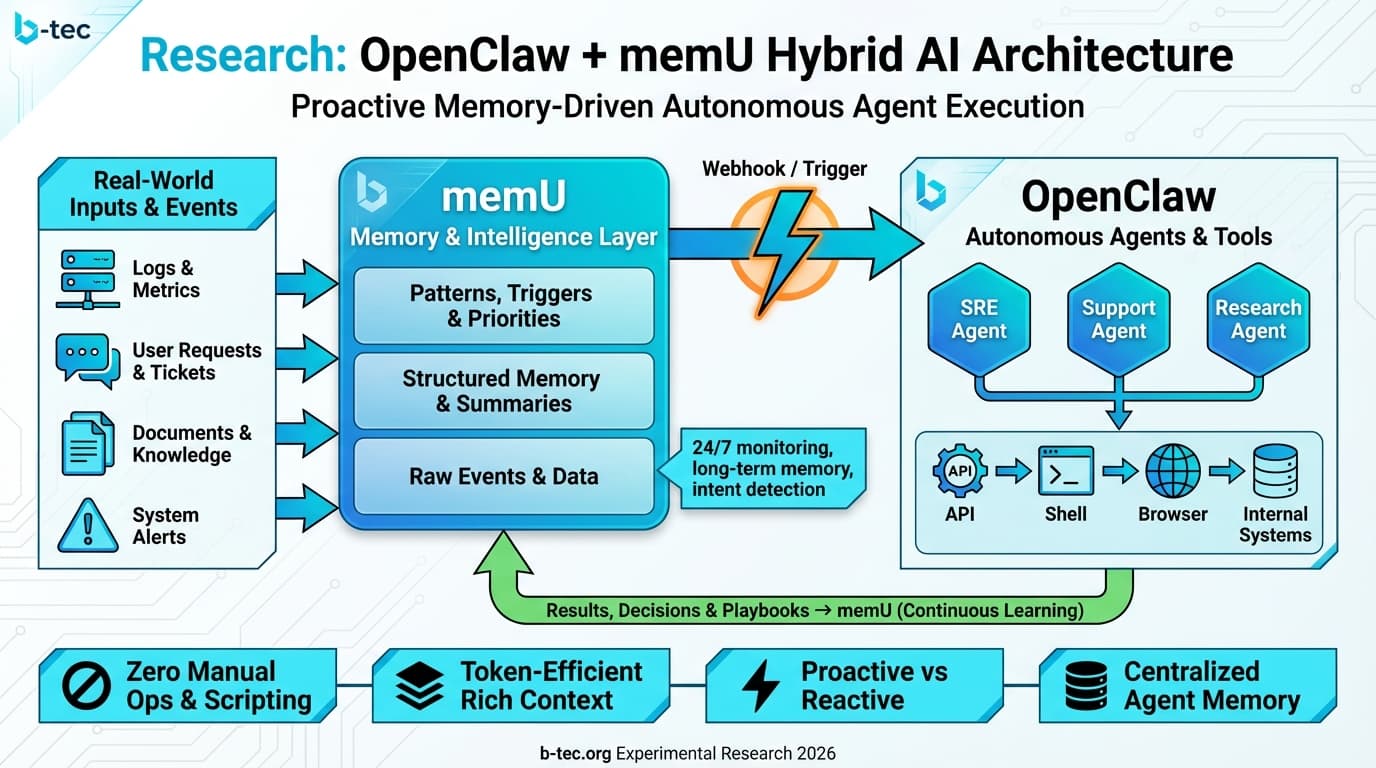
Featured Stack: OpenClaw + memU Hybrid Architecture
A proactive, memory-driven agent execution model where memU acts as the intelligence layer for pattern detection, priority extraction, and long-term context—while OpenClaw executes autonomous actions through tools and specialized agents.
- • 24/7 monitoring + trigger-based execution
- • Continuous memory consolidation from outcomes
- • Multi-agent routing for SRE, support, and research tracks
- • Human-steerable control surface for high-trust operations
RESEARCH EXAMPLE // AUTOMATED IMAGING PIPELINE
Automating Imaging Pipelines: 360 Scan to Web Panorama
For this simple PoC, a room was scanned into Matterport, 360 images from the media library were captured, and one of our digital agents embedded these images directly into the web experience as a small linked tour that it built on this page. This is a simple first step toward a broader imaging pipeline where spatial capture, asset extraction, optimization, publishing, and interactive presentation can be coordinated automatically by agents. (Image capture could be from many other sources. VPiX, 3DVista, EyeSpy360, etc.)
Interior capture from the Matterport media library, embedded directly as an explorable browser panorama.
Workflow
- 01 Scan the room.
- 02 Capture or export equirectangular 360 images from each scan position.
- 03 Store the optimized image assets with the site and label each scan node.
- 04 Link nodes with visual hotspots so visitors understand how to move between positions.
Extension path
The same pattern can support multi-room property documentation, visual operations logs, maintenance records, before and after comparisons, and agent-assisted publishing flows where new spatial media is collected, labeled, placed, optimized, and reviewed before it goes live.
Active Research Tracks
Personal Digital Twin Systems
Client-specific OpenClaw instances with tailored behavior, memory foundations, and controlled autonomy for real-world personal leverage.
Autonomous Agent Operations
Persistent agents running real workflows across API, shell, browser, and internal systems with human-overwatch guardrails.
Memory Architectures in the Wild
Hybrid long-term memory models (file-based + vector retrieval + session memory) for continuity, decision recall, and context durability.
Proactive Systems & Event Triggers
From reactive chat to proactive execution: heartbeat checks, cron orchestration, incident triggers, and morning briefings.
Creative Agentic Stacks
Experimental combinations of open-source frameworks, orchestration layers, and model-routing strategies tuned for real production constraints.
CASE STUDY // SUMMER 2026
Hermes Agents: Alix & Bill
This summer we ran a live multi-agent experiment on the Hermes runtime (Nous Research), separate from our OpenClaw stacks, to see what a small team of specialized agents could actually get done unsupervised on real infrastructure.
AGENT 01
Alix — Junior Dev & White Hat
Alix was built as a junior developer and white hat hacker: building internal tools and utilities, and red teaming larger apps and websites to surface real vulnerabilities before they become real problems.
AGENT 02
Bill — Deployment & Marketing
Alix created Bill, a second Hermes instance on the same server, to help with deployment strategies and marketing for OSP (Open Storage Platform). Bill runs a much newer model version than Alix.
Alix and Bill are being run side by side as a live comparison: same runtime, different generations, different jobs. We are testing and comparing their capabilities for pre-production applications, including assisting clients with their own OSP deployments. Human communication channels: Discord & Telegram
NEW PROJECT
Personal Digital Twins
b-tec is actively developing Personal Digital Twins: practical, client-specific systems that extend a human's output, decision speed, and operational range. At the base layer, this starts with a new OpenClaw instance tuned to one person through light training, workflow configuration, and memory alignment. From there, the stack can stay simple, or evolve into a highly sophisticated digital operating layer as goals, trust, and risk tolerance increase.
What it is
- • A human-steered digital system that helps execute, prioritize, and remember
- • A spectrum: from lightweight assistant behavior to advanced multi-agent stack
- • Built to solve current problems while preparing clients for rapid digital intelligence capability shifts
What it is not
- • Not magic, not consciousness, and not a replacement for human judgment
- • Not a “set and forget” black box
- • Not suitable for low risk-tolerance environments at this stage
Transparency: this category is experimental and potentially disruptive. We frame this work for people with high risk tolerance, often digital builders who are done with status quo tooling and want to explore this frontier responsibly.
This project is directly informed by our recent blog posts: ClawPilled for origin story and field motivation, and The Runway for context on the new technology category we are mapping.
How We Test
Field Conditions, Not Sandbox Theater
We validate systems in operational settings: noisy inputs, mixed data quality, changing priorities, and imperfect environments. If it only works in a clean demo, it does not pass.
Design Principles
- • Real-world testing over demo theater
- • Safety, observability, and rollback before scale
- • Token-efficient, memory-first architectures
- • Human judgment stays in the loop on consequential actions
Transparency Note
This page was co-authored and published through an operational agentic workflow. b-tec (Brian) provided direction, source materials, and final approval; the implementation, formatting, and deployment actions were executed by btec's OpenClaw-connected agent as part of live site operations.
Execution Context
- • Prompt authored in b-tec's dedicated Discord web channel for site operations.
- • Channel routing is scoped to website work (content, SEO, design, deployment tasks).
- • Model profile for this channel is configured for controlled site-building workflows.
- • Messages are processed with sender/chat context isolation to prevent cross-thread leakage.
Security & Access Controls
- • GitHub access is token-scoped and limited to repository content operations.
- • Credentials are retrieved from a vault at runtime (not embedded in page code).
- • Deployment path uses GitHub commit events + Vercel auto-deploy with audit trail.
- • High-risk actions remain explicitly user-directed; no autonomous cross-channel posting.
Stack used for this page: Next.js app routing, GitHub repository commit pipeline, Vercel auto-deploy, OpenClaw tool orchestration, and a digital-agent-assisted content/layout pass driven by real-time instruction.
Prompt used
“We need a new Research page that outlines testing we are doing, new systems and architectures we are trying out in the wild, and new creative agentic stacks like the one attached. can you properly frame out this page?”
Follow the Research Log
Ongoing write-ups, architecture notes, and deployment lessons are published in the b-tec blog. If you are building in this space and want to compare notes, reach out.