b-tec // OSP RESEARCH
Stop being a tenant of your own software.
b-tec built OSP, the Open Storage Platform: an owner-controlled, agent-native, healthy alternative to a rented storage-management SaaS.
The storage software category is overdue for a reset.
Storage-management software became critical infrastructure for thousands of operators, and then quietly became a landlord over that infrastructure. Per-unit SaaS pricing, closed data, and structural lock-in were never inevitable. They were a business model choice, made at a time when there was no practical alternative.
Five ways the current model works against you.
The Per-Unit Tax
Pricing scales with unit count, not with value delivered. Grow the business and the software gets a bigger cut of it, every month, forever.
Closed by Design
Data access, integrations, and automation are gated behind what the vendor decides to expose. The operator rents visibility into their own operation.
You Absorb Their Roadmap
Price increases, feature changes, acquisitions, and end-of-life decisions land on the operator with no vote and no recourse.
Switching Is the Punishment
Migration friction is not an accident. Lock-in is part of the business model, and everyone building it knows that.
Built for Clicking, Not for Agents
Most platforms assume a human clicking through screens. Businesses are increasingly run through APIs, automation, and AI agents. The category has not caught up.
This didn't start as a startup idea.
For decades, b-tec has supported storage businesses and the legacy management systems they depend on. We've worked with the software companies, lived through their limitations, built around their closed systems, and helped clients absorb the consequences: rising fees, forced changes, weak interoperability, and technology aging in place because switching cost too much.
We kept waiting for a better option. It never arrived.
So we're building one: modern storage management software that businesses can own, understand, extend, and leave with, the way critical infrastructure should work.
AI-assisted engineering changed the economics.
Giving every client an isolated, portable instance used to be an operational cost a small technology company couldn't sustain. That is no longer true. AI-assisted engineering makes it economically practical for a small, experienced, and competent team to maintain a secure upstream platform while each client runs a fully separate, exportable system of their own. This changes what the ownership model can look like rather than just a UI refresh with a chatbot bolted on.
For most operators, OSP will cost a company less than most traditional storage SaaS implementation fees. That's it.
Ownable. Portable. Isolated. Agent-first.
Isolated
Each client runs its own instance and its own database. No shared multi-tenant blob holding your data next to a competitor’s.
Portable
Hosted clients get a contractual path to leave, with the repo and a complete database export. Ownership means being able to walk.
Yours, Financially
The client always owns its Stripe account. Money moves through the client’s infrastructure, not ours.
Agent-Native
The human UI, the REST API, and MCP/AI agents all run through the same service layer. Nothing is a second-class integration bolted on later.
Governed Autonomy
Agent actions carry server-enforced permissions, approval gates, idempotency, and audit trails. Automation without a paper trail is not a feature.
What buying instead of renting actually means.
Buy once, use forever
A perpetual license. Remember those? Pay a one-time fee and the software is yours. No per-unit fees, no per-user fees, no annual renewal, no contract that expires and takes your operation offline with it. Four locations under one company, 100 units or 10,000, same price. There’s no renewal date on your calendar and no new quote arriving every spring. Separate legal entities get separate purchases because they get separate books and separate customer data (healthy data boundaries by design). Security and feature updates keep coming at no cost, for as long as you want them.
You own your software
No new tier, no renegotiated contract, no end-of-life notice that quietly turns your license back into a subscription. No acquisition that changes your terms, no roadmap you have to absorb because a vendor decided your workflow wasn’t worth keeping. On hosted instances, improvements and security patches arrive as we ship them, so you stay current without lifting a finger. What you own is the license and the code, and neither can be revoked, repriced, or taken away.
You own your data
Your instance, your database. Your tenants, leases, ledger, and payment history sit in a system that’s yours alone, not in a shared table next to a competitor’s. Your Stripe account stays yours, so rent moves through your infrastructure and never through ours. Every change is logged with who made it and what it changed, human or agent, so the audit trail belongs to you too. If you ever leave, you leave with a complete database export. No exit fee, no ransom, no hostage negotiation, no waiting on us to decide how much of your own operation you get back.
Full source code included
The complete source ships with your purchase. No black box, no vendor dependency. Audit it, review it, hand it to your own developer. You can read exactly how a late fee gets calculated, or how a payment posts to the ledger. You get a link to a snapshot of the codebase, refreshed as the platform evolves, so what you own stays current. If b-tec ever disappeared, your business keeps running on the code you already have.
Subscription optional
The license is yours outright. What’s optional is everything after: support, customizations, automations, integration work. Take it if you want it, skip it if you don’t, and the software works either way. Hosting is priced separately, and that’s covered below.
Hosted by us or by you
Run OSP on b-tec’s managed infrastructure with zero ops overhead. During beta that’s the default and it’s what most operators want. If you’ve got the people and the accounts to run it yourself, we’ll set you up with your own deployment and database and hand you the keys. Same software either way. You’ll always know which infrastructure your data sits on and whose account it’s in. Hybrid arrangements and a fully independent path are planned after beta.
Built for independent operators
OSP is built for the operator who runs the business and works the counter. The home screen opens on what needs attention today and the jobs you start most often. Bring your existing rent roll and the facilities create themselves out of the file. The feature list came from asking independent operators what they actually use, which is why there’s nothing in here priced to justify an enterprise sales team. Per-user feature visibility is on the way, so the employee who keeps breaking the map can stop seeing the map.
Live inventory on website
Your website can show what’s actually available, priced and updated in real time, because it can read from the same system you run the business on. Show exact units or just unit-type summaries, whichever you’d rather publish. Connecting it to your website is an optional one-time setup we can handle, or your web developer can, working from the same API the platform itself runs on. No more price sheets from 2019 and no more phone tag over whether you’ve got a 10x10. No more premiums to reveal your own data.
Disciplined engineering, not promises.
The current build covers move-in and move-out workflows, lease and signature handling, Stripe payments and webhooks, and receipts. It has gone through multiple rounds of internal review and adversarial red-team analysis by separate engineering passes. Here is what has actually been built and tested:
- •Unit inventory and status board: full CRUD, search, and real-time availability across every facility
- •Tenant records and lease lifecycle: move-in and move-out run as resumable, auditable workflows, not simple status flags
- •Stripe card payments and manually recorded cash/check, both driven by a dedicated payment state machine so a failed or disputed charge never corrupts the books
- •Automated recurring billing: nightly rent charges, late fees, and prorated move-ins and move-outs
- •Append-only financial ledger, reconciled to the penny, with balances always computed and never stored
- •Delinquency tracking and end-of-day, occupancy, and receivables reporting, available through the API as well as the UI
- •Append-only audit log on every state change, human or agent-initiated, recording actor, action, and before/after values
- •Agent-native by design: every operation above is exposed as both a REST API and an MCP tool, so an AI agent runs the business through the identical service layer a staff member uses, not a bolted-on integration
- •Security enforced at the database, not just the app: row-level tenant isolation, idempotency keys on every money-moving action, and approval gates that route anything above a configurable threshold to a human review queue, even when an agent initiated it
The map below lays out how this was built end to end, from product definition through incremental milestone development, adversarial red teaming, release validation, and the assurance evidence produced along the way. We're sharing it publicly so anyone evaluating OSP, or evaluating custom software development in general, can see the discipline behind the process.
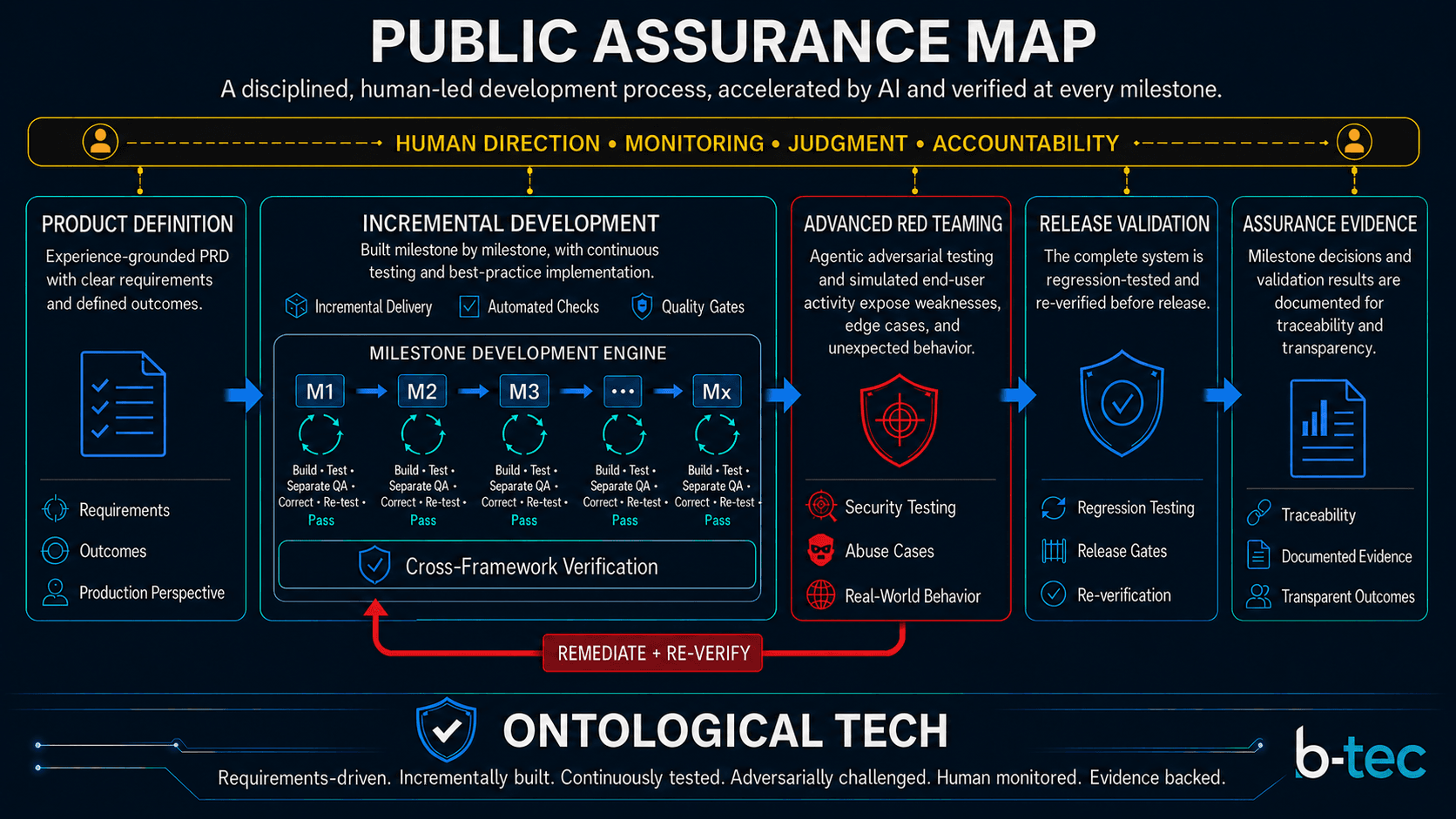
Ask your current provider to share their Engineering Assurance Record (a documented account of how their system was built, tested, and verified). Ours is in the repository.
08 / STATUS
Private beta is now active.
Help shape the alternative.
We're inviting a small number of storage operators who believe their software should work for them, not own them. If that's you, tell us about your operation and we'll follow up.
Request Private Beta Access